Susan Roth: Having Fun
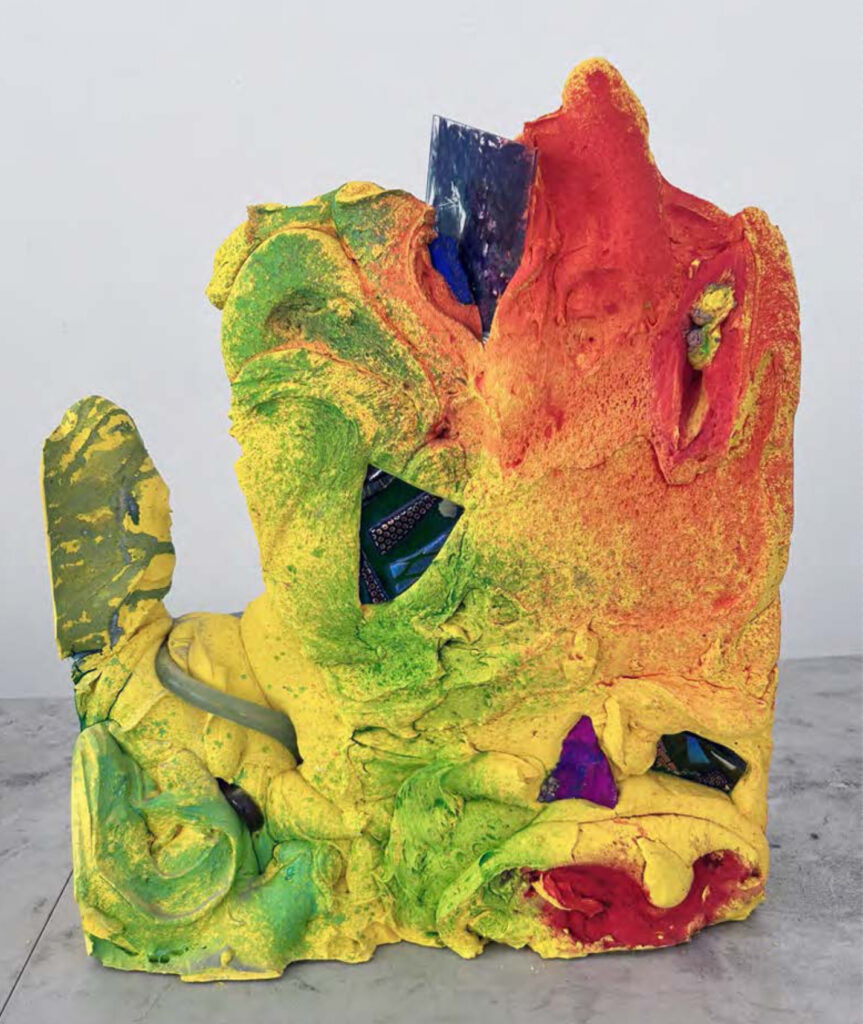
‘Artists have all the fun.’ John Morris
I make decisions: sometimes confident, sometimes frightened, either with or without volition. There is also loss; experience, however, does not subtract. Attitude becomes the true determinant of outcome. This explains how I proceed; how I go about making objects. Problem-solving is connecting to the possible when uncertainty presents opportunity. That’s how I knew I would find a way to work outdoors, reflecting nature. This is the story of my work in synthetic stone.
Twenty years ago, I was invited, with my husband, Darryl Hughto, to lead an artists’ workshop at Featherstone on Martha’s Vineyard. My head filled with images of ocean waves crashing on the island shore I had so sorely missed. I signed the paperwork with glee, agreeing to a 15-day workshop the following summer. Midwinter, Darryl asked if I had given much thought to my approach to conducting the workshop. It seemed I had neglected to read the paperwork thoroughly: I now realized we were supposed to take a group of between 12 to 18 professional artists to historic Vineyard landmarks to paint en plein air. This way of working is not something I can’t or won’t do; but in this instance, I simply didn’t want to set up an easel. I have been told I am defiantly singular: I have always wanted to work in nature, though not in a traditional way.
Looking for an art that presents a natural awareness of itself by integrating all sensory responses might mean escaping the studio. This could be understood as a retort to Frank Stella’s description of Caravaggio’s intensely individualistic pursuit: that of turning the artist’s studio into a cathedral of the self. Perhaps, like Brancusi, I seek the essence of natural life and its materiality. I want to step outside of myself. Like any artist, I set the conditions of the problem, thereby marking the parameters of the creative impulse. What I have to share is my commitment to approaching discovery. We reconstruct backwards; and although the creative act is the antithesis of reaction (art does not balance opposing views), I can describe the events, the thoughts I had or have, but not the moments in between, that liminal space of uncertainty, doubt, fear. Chance awakens this possibility to reflect and share; this is where my story begins.
I was twelve. I was my father’s companion on his regular visits to my sister’s grave. His grief consumed him. I do not remember how it began, our going from the cemetery to the beach, my father carrying two buckets, one empty, one full of plaster, and in his pocket an omega hook – a kind of fishhook- that he had fashioned into a hanger. We made the journey in silence. As I piled and dug into wet sand my father waded into the shallows with the empty bucket to fetch water for mixing the plaster. When something was worth keeping, he would pour the plaster.
We sat in silence, watching the waves, checking the timings for setting the hook. We lingered. When the plaster was set, I carefully carried the new object home. In sharing this different language, we found a new way of feeling. It was a magic bridge where touch heightened one’s agency.
These were the memories with their embedded transformative lessons that prompted me to seek out Mark Golden of Golden Artists’ Colours. Mark (and his father Sam before him) had the empathy, experience and expertise as a developer of painters’ media to understand my goals. What I had in mind is perhaps best described by Walter Darby Bannard: ‘Originality appears within style by means of execution. Execution is the direct and immediate application by the artist to the art he is working on, what he does with and to the materials at hand. It is the living source of art, and the vehicle of originality.‘1Bannard, W D., ‘On Originality’, Arts Magazine, September 1985, pp 132-133
To explain what I was seeking: plaster in art is usually a means to an end, rather than art in its own right; used in casting and often lost in the process. I knew the story of Picasso’s love for the two female busts he created in plaster being so strong that he repeatedly refused to lend them to exhibitions, fearing for their fragile nature. I wanted, I needed a paint-like medium that shared plaster’s expressivity whilst transcending its fragility: and all of this in full spectrum colour! Mark understood. Before long, trials began and bore fruit: I felt everything shift; the self-supporting painting I’d hankered after, a kind of painting, free-standing, like sculpture, might be a reality. As with Scholar Rocks (stones sculpted by the elements into evocative miniature landscapes, objects of contemplation by Chinese connoisseurs for over a millennium) I might find a form that, like nature itself, captures the randomness and unpredictability of life, and the resulting object would be perhaps what it was, rather than what it looked like. Here, as I began, I knew that I didn’t know what would follow. Creativity is organic, unconscious work, that inspiration and memory often do not assist us in processing. Trial and error are the work of a language new to everyone.
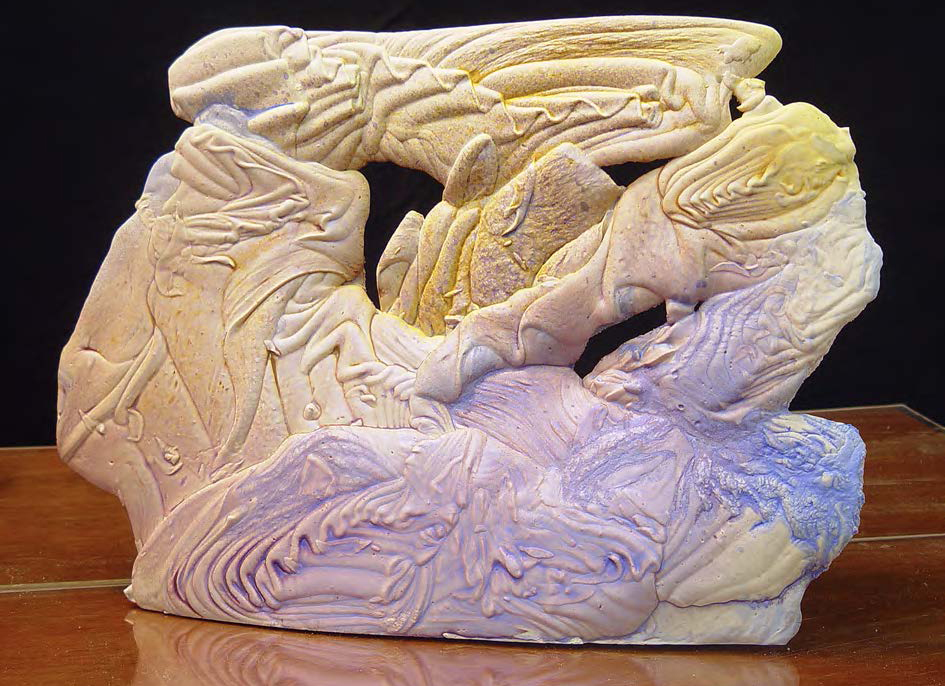
It has been a long gestation. My restlessness, my resisting repetition, refusing habit and convention, fed a lot of miscalculations, errors, wrong-headed mistakes. I returned home from the workshop with only two finished works: ‘Featherstone Sunrise’ and ‘Featherstone Sunset’.
Like acrylic paint, synthetic stone is a forgiving material that excels at matching emotional experience to form. Small changes, such as varying the water-to-pigment ratio, choosing one acrylic modifier (a specialized additive, an acrylic polymer emulsion designed to enhance the performance of cement-based materials) over another, create huge effects. The resultant mass of frozen energy can embody the secret of movement, like the great Chinese painting of the past, and colour might partner with form.
With ‘Mrs. Dalloway’, Virginia Woolf’s novel in which time itself is subjective, as my guide, I knew I would be forced to abandon any plan. This change of material would be like tending the garden: each season a new story, with matter mattering.
Synthetic stone gives to the moment of condensed experience a structure that holds abstraction; and, as in a dream, the delivered explanation is intuition. St. Augustine truly believed choice is ultimately a question of habit and company; with that in mind, alongside my belief that hostility to influence threatens originality, and that doubt is as vital to the work as any material, I will name the forefathers who preside over my journey into working with synthetic stone.
Here was the stuff: what was I to do with it? The answer is always the same with me: off I go to my library. It is here, surrounded by my collection of books and catalogues, that I tour my history of looking at art in the flesh. It is here that I read and recollect what others have felt before me.
It is no wonder that memories of Medardo Rosso flooded my practice. My mother was a fan; we saw Margaret Scolari Barr’s 1963 show of Rosso’s work at MOMA multiple times. Standing beside me, my mother wept as we gazed. Was it the work’s heightened sense of presence that stretched time? How could something so small offer a wellspring of emotions so big? In Rosso’s work, the architectural construction of bodies is somehow divested of form and made sensory. When faced with a dichotomy, the face or the curtain we see in Ecce Puer, we sense an integration of all cognitive and emotional responses as one. What remains feels embedded for the beholder to contemplate. As with El Greco or Kafka, gesture is decisive – it is the main event. It seems to me the size of these works is in an inverse ratio to their felt significance.
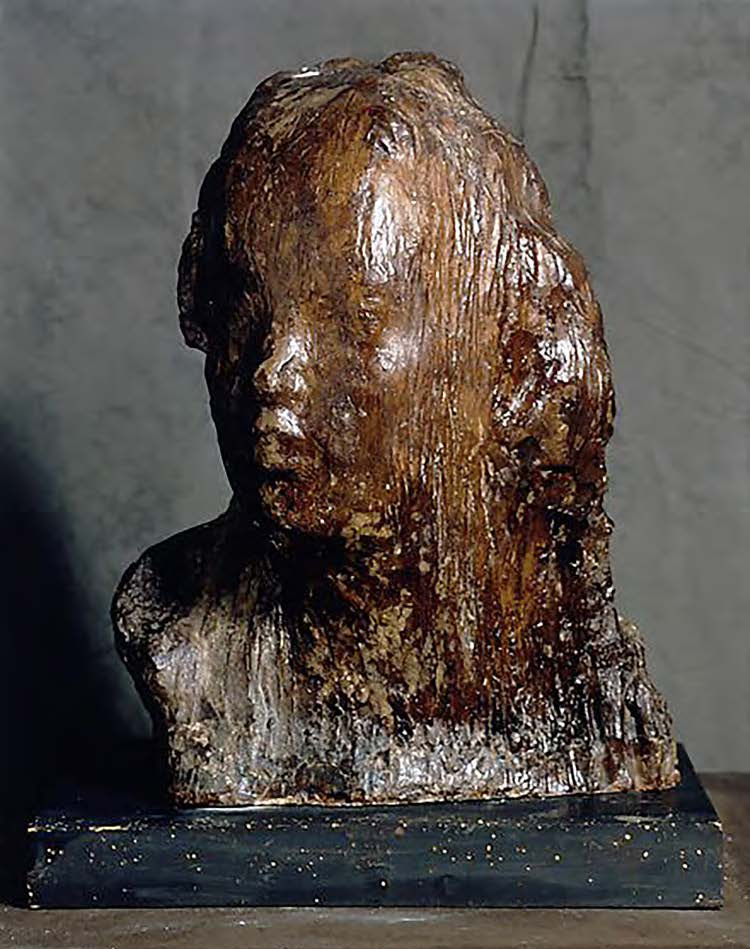
Their pictorial nature, their fractured surfaces giving shadows their say, coupled with their small size, allow for intimacy. Rosso allowed back, front, sides, top, bottom, through and through, all to convey a declaration of life. As Chopin divulges, it is the physical act of playing that is the work’s emotional substance; this might also be said of Rosso. You feel his uncertainty, remaining as enigmatic as all our lives. Like Bernini heads rising out of the flow of modeling, gone is the arrangement of the planes to be found in Greek figures. Now, as I pore over the MOMA catalogue my mother bought us, (an uncharacteristic gesture on her part), I want to approach the material from this standpoint: having the synthetic stone so close to paint as to allow structure as design; discovering the geological process of pouring synthetic stone where structure is inherent, natural through intention, and perhaps witnessing the collapse of distinctions within my oeuvre.
The hope is to once again have the capacity for reinvention. Between the artist and material there is often a tart ambivalence. What binds us to our mediums? What might be the connections between various processes? Can I stitch together these chapters of my work as Charles Dickens does, binding story and voice? There was a radical rethinking of limits and possibilities when that first bucket was mixed. And once home from Featherstone, the workshop that gave birth to this venture, I found myself lost in contemplation, gazing at these two works. I knew that stirring, the transduction of feeling, becoming an impulse to work. The authority of the material pushed me to consider history. More than a responsibility, I find faith in tradition. My library serves as the reminder; my memory of the physical character of the works that form my point of view.
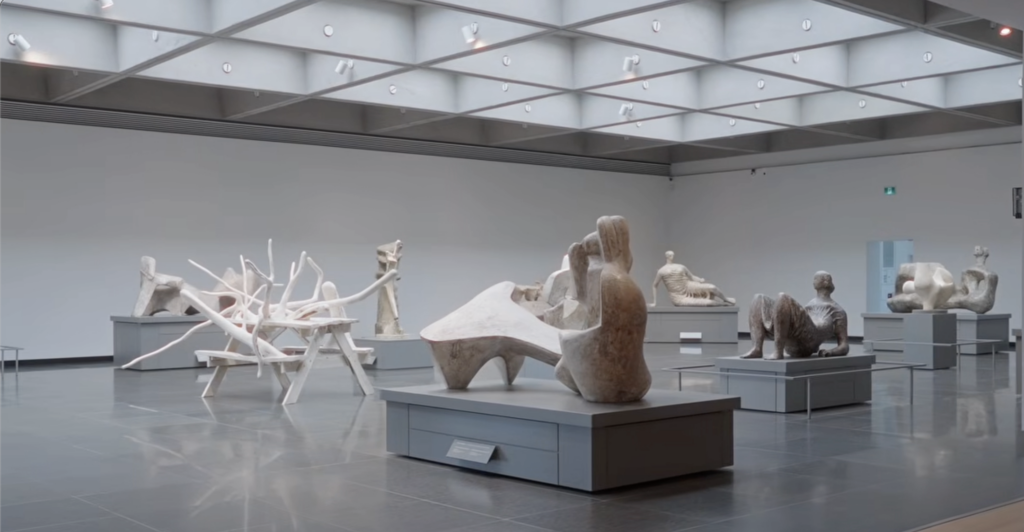
The ghost of Rosso took up residence within me, prompting questions regarding scale, size and the oceans of fair weather between them. Long before my recent foray into the free-standing work of art, Henry Moore’s gift of plasters to the Art Gallery of Ontario, Toronto, Canada, where there are over 300 of his works in various media, offered me an object lesson. From 1974 forward, I have repeatedly visited, using this distinctive opportunity to view choice-making in action: Moore’s decisions regarding size and surface. In front of Moore’s work, I began to evaluate both bigness in space (inherent size) and that comparison, which is scale, of this to that, this object in relationships.
Moore’s smallest works question the capacity of monumental feeling and its necessities captured in time and space. This one big; that one small: what exactly was I looking for? While Moore’s notes were helpful, it was through the repeated experience of looking that I came to understand the intimacy and simplicity I now longed for in my synthetic stone and how it might be achievable in my small works. Works of art, as Moore states when referring to Cezanne, ‘…take on a nobility that raises everyday life to a height that gives you new faith in it, and a new excitement.’ Cezanne brought nobility to the act of working. No guarantees: rather than aim for understanding, like a kind of target practice, see it as one footfall followed by another.
Arriving at the starting line with these two objects from the workshop, I was reminded of scholar rocks of the Quing dynasty, in the Kangxi period, natural forms of embodiment of life’s energy. Form here confronts mystery, permitting endless contemplation; their scale opening inside the viewer. Gogottes, another naturally occurring formation, presented a stunning comparison. Found exclusively in Northern France, they are composed of fine quartz grains, nearly pure silica, formed when silica-rich water seeped through sand, cementing a beautifully fluid form.
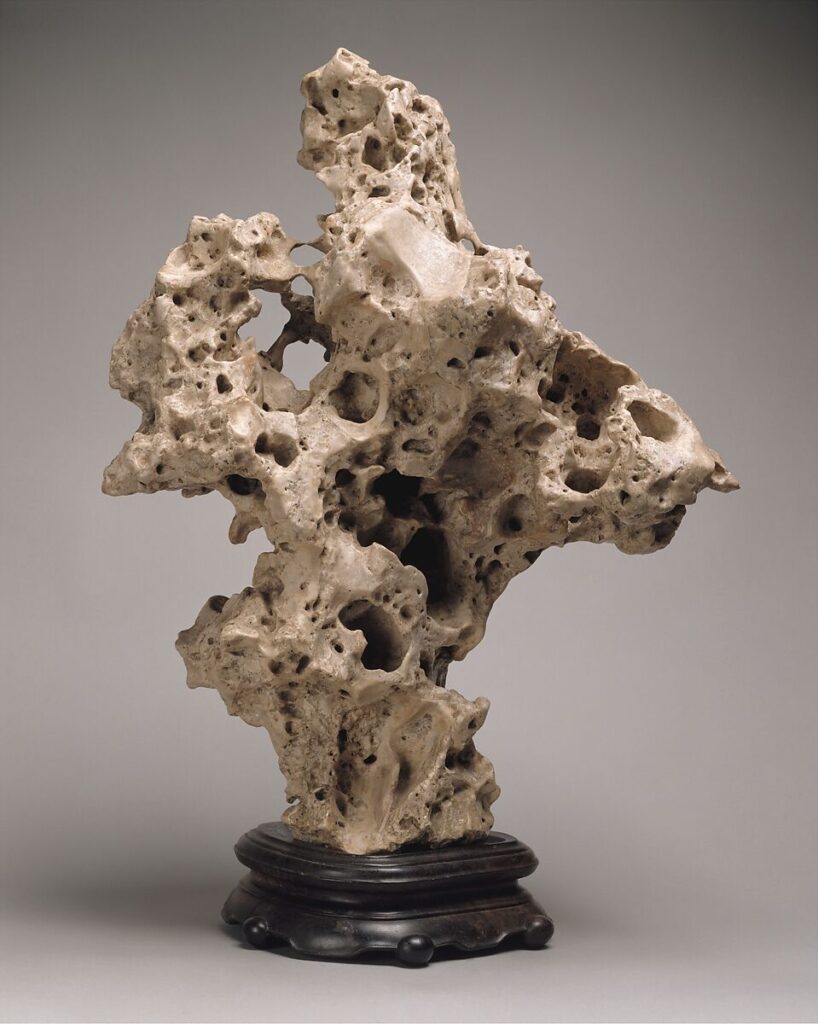
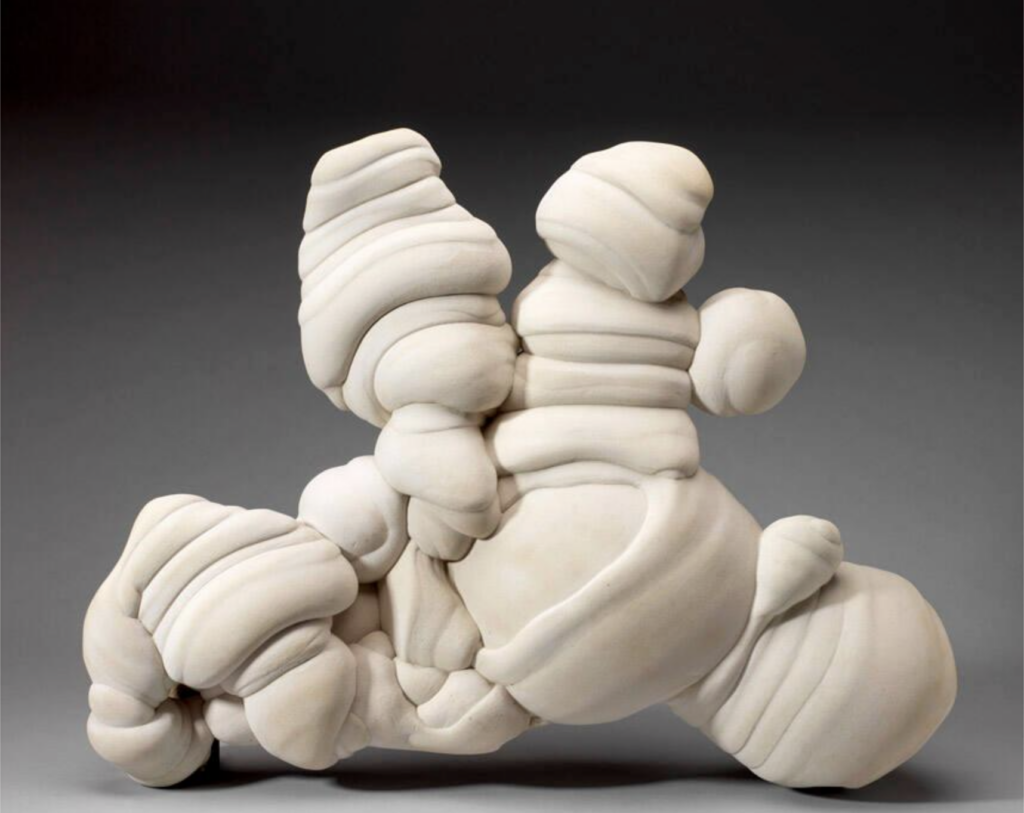
I knew them (though by now in a blackened state) from the gardens at Versailles. I was surprised when my grandson pointed out a fabulous Gogotte while we were visiting the Royal Ontario Museum, Toronto. We saw form determined by the flow of gravity, its mold being the sandbar in Fontainebleau in which it had formed roughly 30 million years ago. In it there was no resistance, no evidence of the hand. And yet, despite its beauty, there was something overly static about it.
Simultaneous realities, contradictions like freedom and boundaries might resolve in touch. Touch communicates intimacy. This reckoning would send me back to Charles Millard’s landmark book, The Sculpture of Edgar Degas.2Princeton University Press, 1977
I cannot remember when I first met Charles Millard, Charlie, as it seems that he has always been present. Charlie had family not far from where I live in upstate New York; and we shared a love of opera (Glimmerglass Opera is close by). Charlie visited over many summers, beginning in the early 1980’s; we became friends. I have read and reread his writings on Degas sculpture, always hoping to be prepared for his next visit. The unexpected occasion when we roamed Washington’s National Gallery of Art together, spending more than an hour with the collection of Degas sculpture, is a memory often on replay. This tour remains with me as a series of lessons. These lessons, these reminders, are the orderly chaos that touches on my understanding of my personal history.
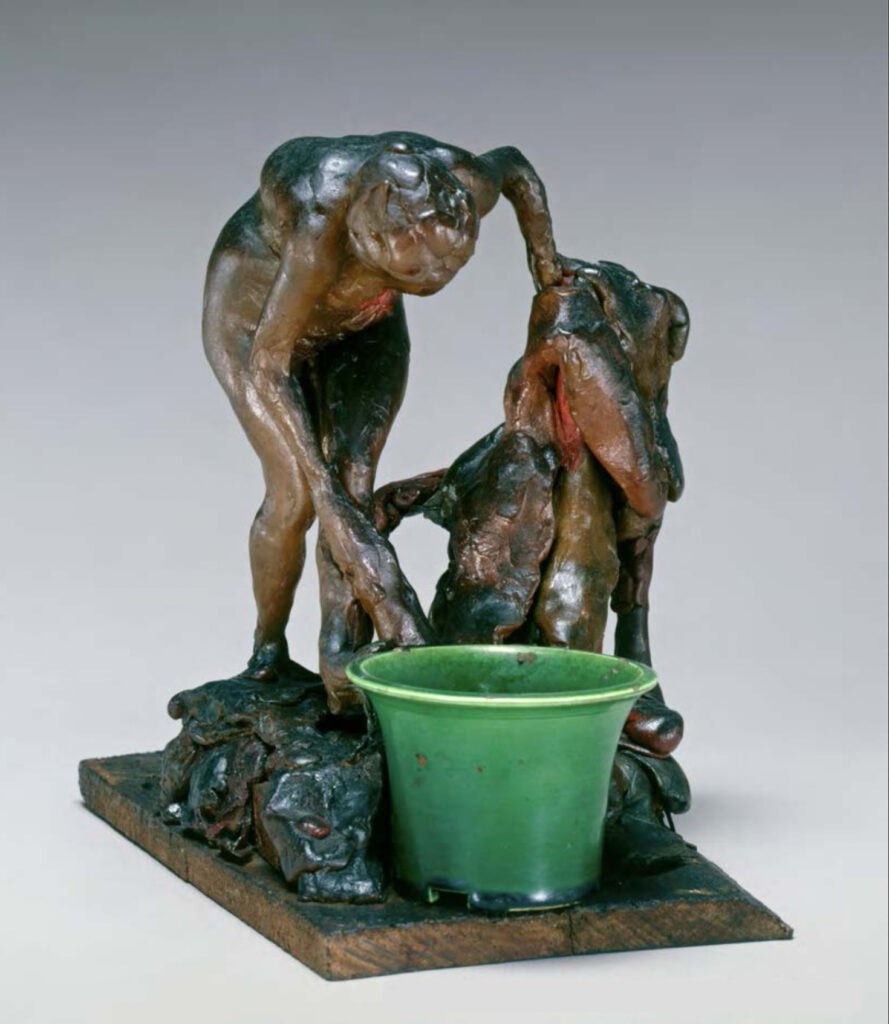
Charlie would often quote Mier-Graefe: ‘Degas had employed alien substances to give life to his work instead of just using his fingers on the wax […] perhaps one day there would be sounder practices.’3‘Degas’, Mier-Graefe, J. Alfred A. Knopf, New York, 1923. This insight has given rise to my belief that everything I do is painting.
The significance of Degas’ achievement should be understood: he freed sculpture of its pedestal, thereby giving way to a new relationship to both kinds of ground, (floor, tabletop) using surrounding space in partnership. Charlie called attention to Degas’ finish, neither smooth nor careful, rather, filling the surface with pictorial life. Degas was influenced by Rosso. Here was where I might begin with synthetic stone, making objects abstract as Cezanne’s pictures and finding unity by means of construction. Charlie reminded me: we feel satisfied, though we may see the work as unfinished. Michelangelo’s Slaves and his use of Non Finito (meaning ‘not finished‘, his revolutionary technique of leaving parts of marble rough) prompt through carving; the artist discovers what the stone reveals and withholds. This is that ‘stellar region’ that John Coltrane left to Alice Coltrane to expand beyond from another time, that space of elsewhere; that self-same space described in Gaston Bachelard’s ‘Intimate Immensity’. It is this dialectic of inspiration itself, the ‘knowing and non-knowing’ Bachelard speaks of that grows inside us, holding soul and imagination. Perhaps here might be a wonderland where bigness, monumentality, expand, where space itself is limitless (inside us); perhaps this is that ‘moment between’ Renoir describes to his son Jean: ‘Before him (Degas) only the Chinese had found the secret of movement. That is Degas’ greatness; movement in French style.’ To this end Degas coloured and clothed his sculptures, incorporating lived experience directly through the use of the found object. Change is inevitable. Managing change is essential. Balance keeps shifting, and like Piero della Francesca piecing together different units to make an altar piece, emotional drama gives way to light and equilibrium is felt. Degas was able to intuit more about the direction of history than those who may claim to steer it.
Synthetic stone has a craft-like depth that makes a pure beginning difficult for newcomers. I began again after the workshop as we all do, by using what I know. I brought the beach home with me: big buckets of sand to cast in. While allowing all measure of influence, the material began announcing its language, posing me an age-old question: the challenge of colour. Does colour belong to form? Is colour derived from form? Or do we heed Plotinus: ‘Colour is devoid of parts.’ Meaning, do we feel it whole?
Colour is the metaphor that lends continuity to artistic traditions. It is colour that marks many divides: between Delacroix and Ingres, for example. Delacroix sought to capture light, assembling palettes with all the available pigments of that era, employing colour as a constructing medium. His pictures are composed and unified with and by colour, the relationships between colours giving his pictures their structure. Ingres insisted on line; for him, it is form that establishes the painting. I stand at the crossroads: I do not want to make polychromed objects. Conceivably synthetic stone, so close to paint, would carry colour as form and be the challenge to the classical belief that we see form as proportion and symmetry. Would works in synthetic stone read as self-supporting colour?
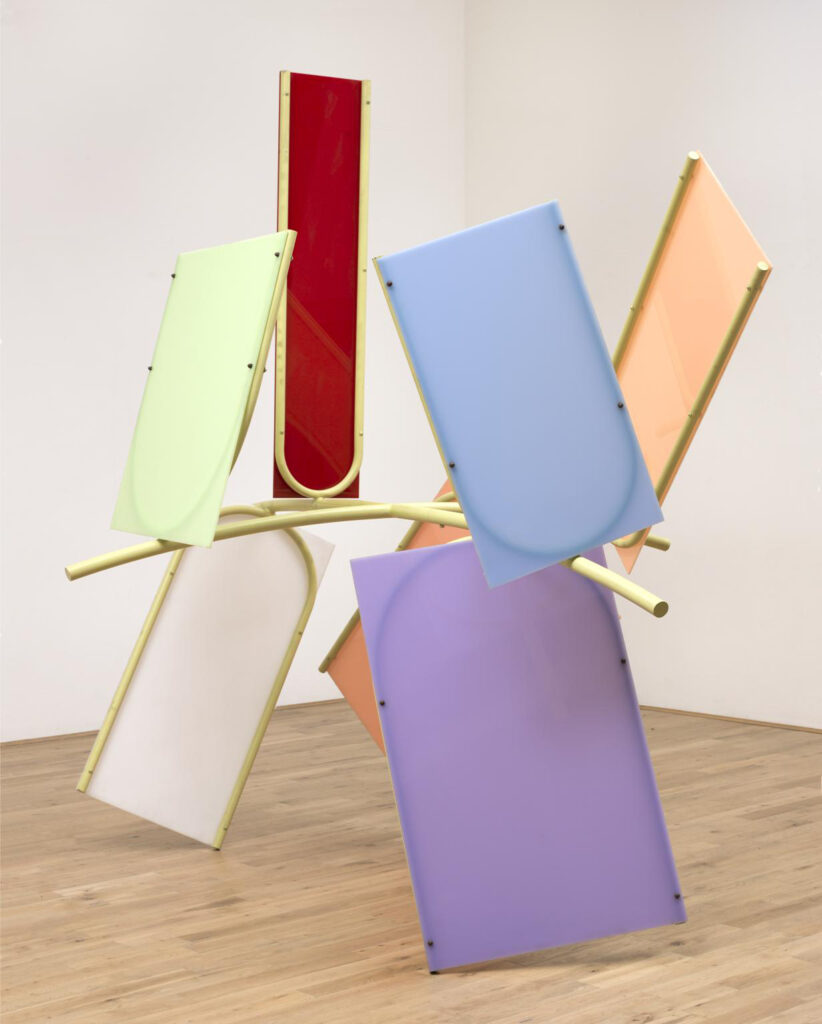
A new material is a change in practice, dreaming in a different language, one not tethered to experimentation and inquiry as in waking. What I see in my dreams requires no foreknowledge or new technology to make. Once waking and wanting I am bound to discovery with its need to experiment. As well as the inexhaustible pleasure they provided through their sheer plasticity, the sculptures in Tim Scott’s 2010 Everson Museum show, (Syracuse, NY, installed in I. M. Pei’s perfect square-box galleries) through their engagement with a new material (coloured polycarbonate sheets) shouted ‘intrinsic colour’. No other modern colour sculpture embodies the unprecedented welcoming of colour as does Scott’s ‘Bird in Arras’ series. Scott created a new conception of what colour might do, expanding its field of reference. He posits gravity as revealed by colour. Sam Cornish’s book, Ten Sculptures by Tim Scott 1961-1971, is indispensable to understanding the extent to which great works are built on discovery.
Synthetic stone is a material of intrinsic colour, not subservient to line, rather to texture and consistency. This material shifts the boundaries of colour and application, allowing size to be compact. My synthetic stone work might be, to quote a friend, Diane Novetsky, writing about my synthetic stone object, ‘View of Toledo’, ‘…defined by the flow of gravity and the constant of the mold… the work seems to contradict itself, expressing both freedom and boundaries.’4Novetsky, D, Instagram post, February 22nd 2025Touch delivers the truth.
Each time I return to this material, I search for new ways of working. Like Chesterton’s fence warning against change for change’s sake (Chesterton’s 1929 book, The Thing, was a parable rooted in the principle that one should never remove or alter a practice until understood; the burden is on the one who changes the form. It is a call for humility), synthetic stone removes the need for canvas or board or paper or … it removes the need for support. So, while the internal movement of finished pieces remains similar to the roiling canvas and paper works that preceded these objects, these stone forms do not need support for their gesture, though it would be a false dilemma to choose: I will continue to paint in all various media. Synthetic stone, free-standing painting, seems to return to abstraction what Abstract Expressionism seized from it: depth. Abstract Expressionism, where space collapses to all surface for feeling, is different than space condensed in an object.

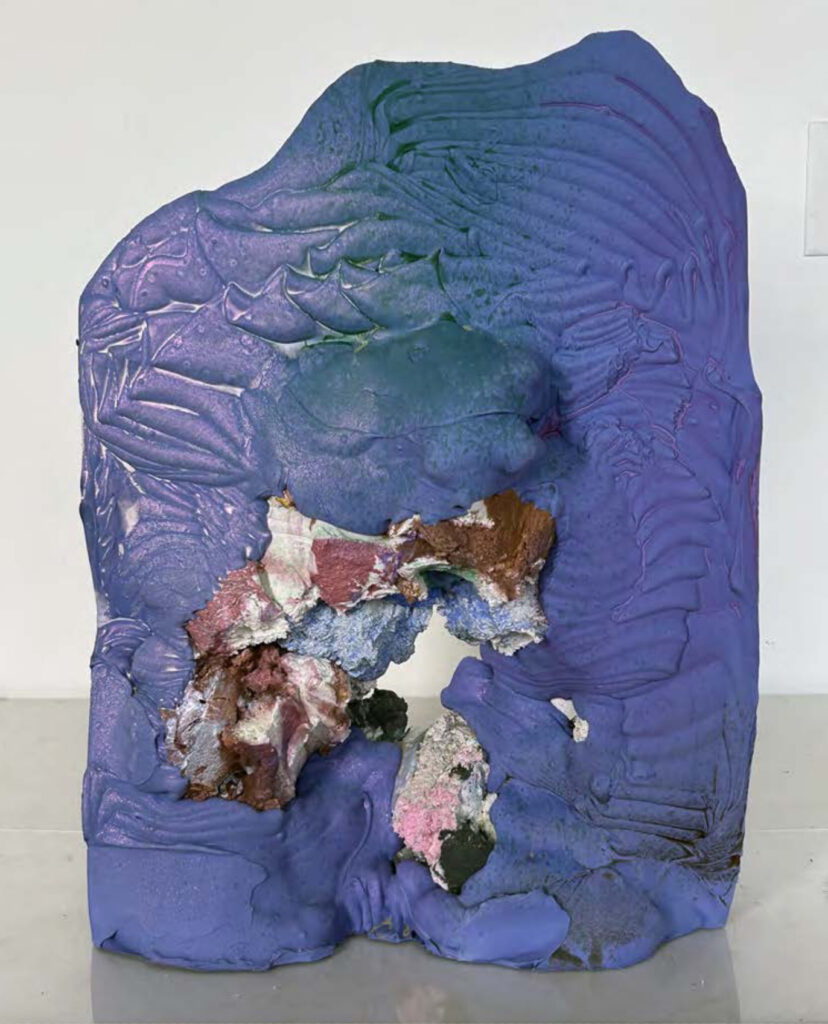
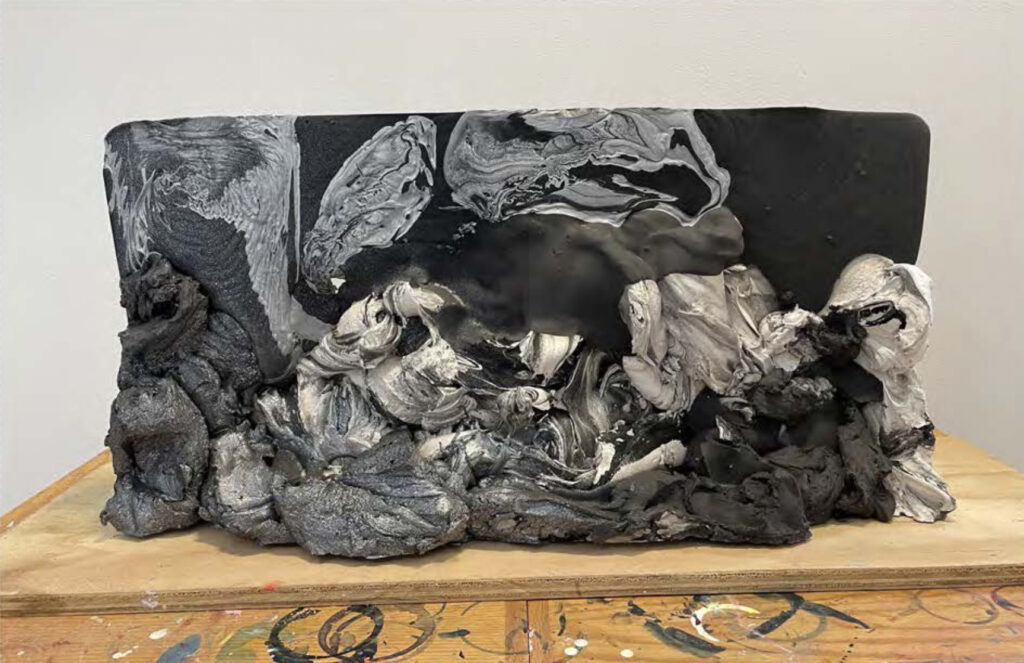
Working these 20 years, in fits and starts whenever able, working still in sand buckets, it seems I have slowed the pace of my looking, not focusing on discrete events but finding hidden patterns of practice, finding the relationship between one foray and the next. From ‘Featherstone’ I traversed Asian landscape influence (‘Menemsha Bight’, ‘Foo Dogs’, ‘Plato’s Cave’, ‘Galactus’), and Buddhist figurative art (‘Princess Longrock’, ‘Yojimbo’), coming to understand reworking as a reinvestment, returning a piece to the mold (‘Blue Bayou’, ‘Day for Night’), gradually incorporating more and more found material, (‘Good Day Sunshine’), refining the material for a porcelain-like finish (‘Black Cat’).
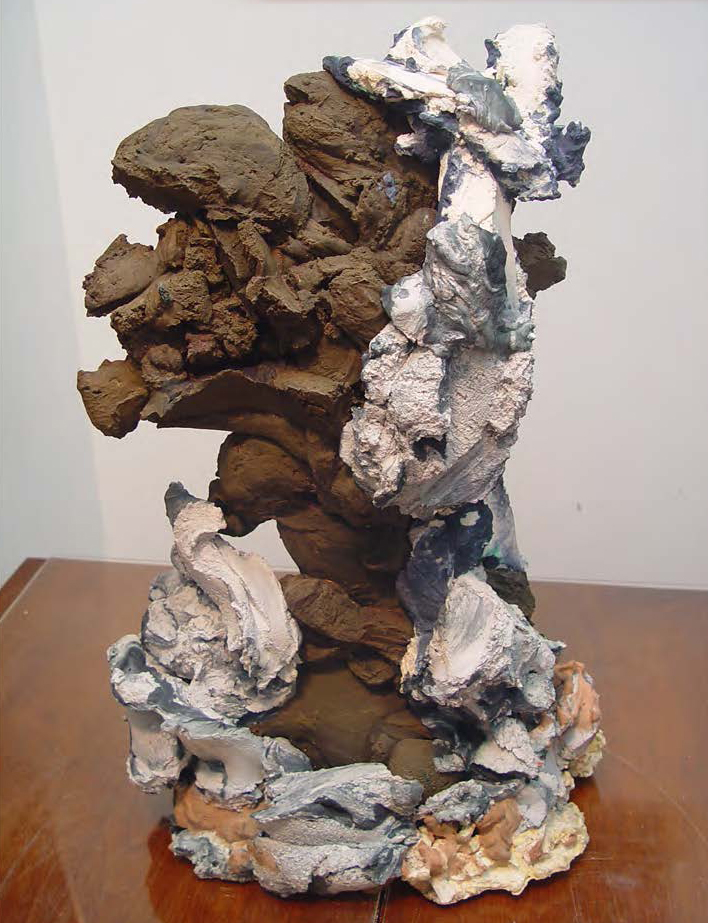
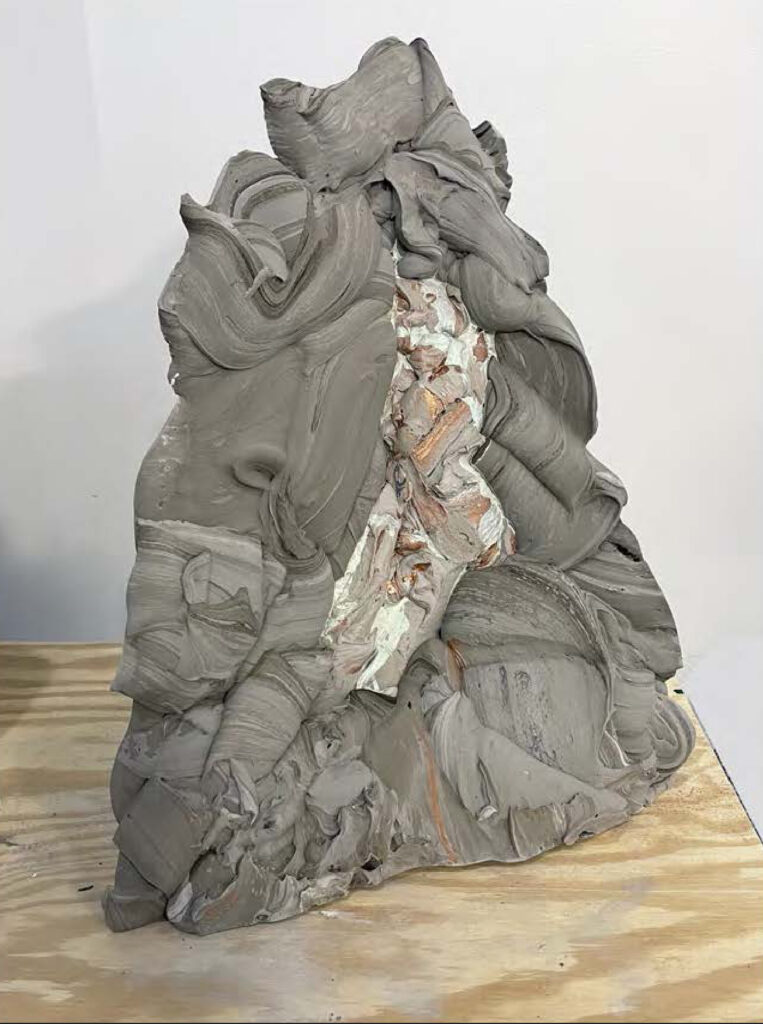
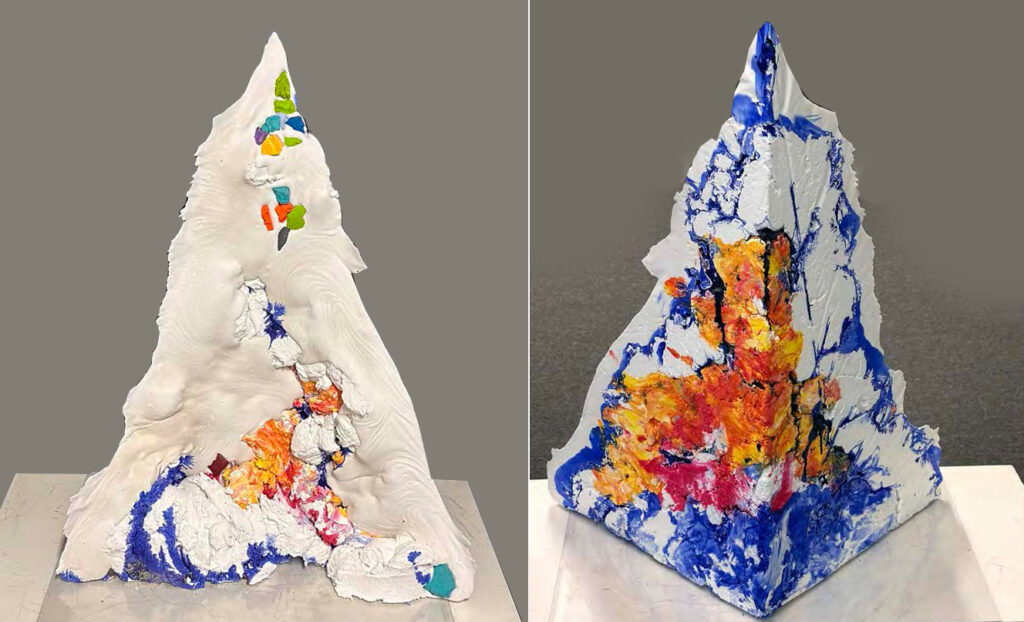
Then came a convergence of emotions & experience. I needed another way of working. As if living in a beach house, sand seemed to follow me everywhere; I could find no end-game to working with it. Noticing an odd-ball work of mine posited on a corner molding, it was Tim Scott who led me to deploy the wedge. We built the form, a corner, and it became ‘King Tut’; ‘Snow White’ followed soon after. The new complexity of three sides changed my optical bias: painting has more than front and back! It feels tentative, uncertain, not seeing the object when wet in its piece-mold, a hollow form that holds the object. After it emerges, its corporality is established out of its form, space-dependent, with its movement made permanent.
Nowhere is this duality more evident than in the work of Nishida Jun. I was with my family visiting the Boston Museum of Fine Art. I opened the door to a gallery with lighting dramatically dimmed. I froze, causing bumping of bodies behind me. Before me, startlingly there, was the work of Nishida Jun. Nishida took the kiln, and what its fire does to various clay bodies, and the tradition that goes with it, and changed the balance between chaos and creativity. I found hope. I would continue; others, I knew, would jump in: some already have. Process defines authenticity and its journey is genuine.
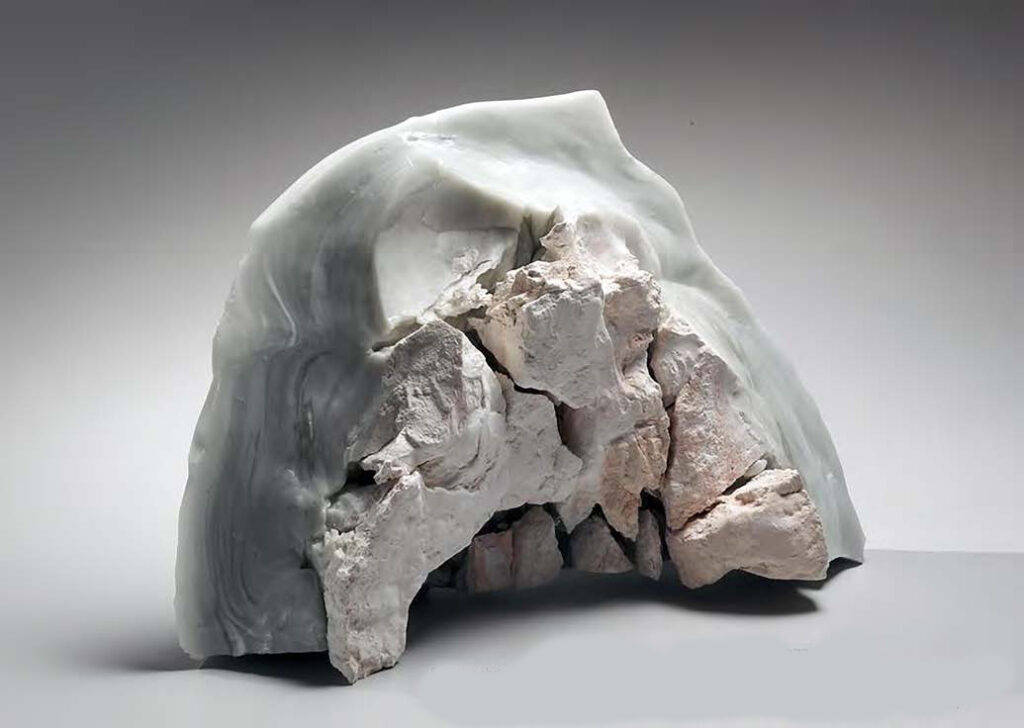
32 x 47.5 x 17.5 cm
I knew, although it might strike some as insufficiently serious, frivolous even, to write it, that I would have fun. And as my Nana advised: ‘you cannot compete with someone having fun!’
6 thoughts on “Susan Roth: Having Fun”
This is all too cool—2D/3D—I work with paint, sticks & stones, just found Aves 2-part sculpting stuff to make bases for the stones—will probably take it in other sculpture-like directions—thanks for your works and insights!
Thanks! Have as much fun as you dare!
Thank you Susan for this – I savoured every word. So generously wide-ranging in offering glimpses into what contributes to your working life as an artist. Inspiring. Will enjoy even more now the images you post of the ongoing works. x
Most kind! Thanks!!!
I approach every new essay from Susan with keen anticipation. Her insights about art are superb & always, always teach me something.
Very generous & I will continue to strive to share.